





(The failure of law schools; when to take LEEWS; much more. . .)
"There is a system for
handling the law school essay exam well. It's the single most important
key to law school success. Its creator is Wentworth Miller, founder of
LEEWS. A friend who made law review discovered that every one of his fellow
editors had taken LEEWS in their first semester of law school, as had he.
Other than this book, LEEWS is the best thing you could possibly have going
for you."
—PLANET LAW SCHOOL (1998), pp. 83, 89.
(Read our review of this provocative book and the full text of its description of LEEWS, and a review of PLANET LAW SCHOOL II.)
There is a lot here. The problem of successfully handling
law school and especially preparing for and taking all-important law school
exams is complex. The aids/advice competing for your attention are many,
including what law schools and law professors offer.
However, at this point in the term -- December exams fast approaching;
mountains of class notes to make sense of; just getting started on course
outlines; midterms (or looking at old exams) having persuaded that you
face a major problem --, what you want to know is ...
IS IT WORTH TAKING A DAY OFF FROM OUTLINING TO ATTEND A PROGRAM IN
A HOTEL SOMEWHERE (OR DO THE AUDIO PROGRAM)? ... CAN LEEWS REALLY HELP,
... MAKE THAT BIG A DIFFERENCE?!
Our emphatic answer is "YES!" Early in the term would have been better,
but anxiety over approaching exams will make you very energetic and efficient
in the next couple weeks. Here's some good news! The cluelessness of even
the smartest law students respecting what is required and how to address
confusing law essay exams is your great ally. (They've been busy mostly
briefing and taking [largely useless] class notes just like you!) If you
can acquire skills and a system that they lack, you'll be among the front
runners.
Consider the reaction of one Lauren Grous (U. Miami '07), who attended
a live LEEWS program at the end of November in her first term (one of over
900 attested student reactions at this website, from over 190 law schools!):
"Very valuable program. Exams begin
12/3 (next Friday), but I feel as if my possible study/freak-out time
was well spent. Thank you!"
[Indeed! Lauren wrote us in June '05. (Letter
reprinted under "Results.") She received 3 A's, a B+, and
a B first term. More practice with the LEEWS system and instruction
in spring term (which term she described as "FUN!") resulted in
all (5!) A's. Of course, Lauren went on to make law review, become a TA
(and send 14 of her tutees to LEEWS), land a federal clerkship, etc. Hers
is a LEEWS story repeated over and over.]
Here's the deal, the so-called "bottom line." What your professor
wants to see, what every professor in every law school wants to see
(!!), whether they know it or not, is a lawyer well versed in his/her
subject area coming off the exam page. (What else could they want?!)
Only those few students who approximate this, identifying relevant issues
and applying relevant law to relevant facts in the dialectic known as "lawyerlike
analysis," will compete for rare law school A's.
The idea that only a few students are capable of this, and therefore deserving
of A's -- i.e., have an innate lawyering genius or aptitude ... The Right
Stuff! -- is a myth, a self-serving myth. (Justifies the failure of law
schools and law professors to adequately train lawyers; flatters those who
get A's, including law professors.) Some few students do have a habit of
mind that lends itself to such analysis, normally acquired long before long
school, but every law student is capable of such analysis. Most will learn
the art only when actually practicing law. Law school "case method" instruction
is ineffective at conveying it.
Because law school instruction fails utterly to convey HOW, exactly, lawyers
pull apart and analyze complex fact patterns, the great majority of
law students, even at Harvard, will have no shot at A's (!!). Confusing,
intimidating essay "hypotheticals" will immediately put even those students
who seem brilliant in class on the defensive.
Most law students (over 85 percent) flounder, flail, and produce a rambling
mess that has no resemblance to what a competent lawyer would produce. The
B's awarded as a matter of course at most top schools are a gift.
In fact they are a bribe, an attempt by professors and the schools to mask
the ineptness of their instruction (!!).
That's where LEEWS makes the difference. No one has devised so effective
a process for breaking down ANY essay fact pattern to reveal relevant issues.
Not even close. No one instructs the art of analysis so thoroughly and
effectively. And no one has developed a format for presenting analysis in
concise paragraphs that impress -- roughly one per issue -- that approaches
ours. So inept are the great majority of law students, that even students
who attend our 11/30 live program in NYC will compete for top grades in their
classes. It has been so for 28 years!
It is not easy to convey the depth and effectiveness of our instruction, the uniqueness of our insights, and how very different and how much more effective LEEWS is compared with ALL other study aids. Read the attested remarks from students at your school. Read the Message(s) of the Moment. Read the Basic Truths. We want to provide as much information about what we offer as possible. We also want to provide you with useful free information and advice. Here's the first and perhaps most important thing you should know:
Law school requires hard work. However, . . . law school need not be mysterious, confusing, intimidating. It should and can be stimulating intellectually, even fun. Certainly, success in law school is within the reach of any person of reasonable intelligence. As Mr. Miller (LEEWS founder/instructor) likes to say to classes, "If you can find your way to this program in a room in a hotel in this city/[suburb], you're capable of 'lawyerlike analysis'" — the key to impressing professors and doing well on law exams. What is necessary is to work hard, but also smart, …to acquire the necessary new and unfamiliar skills needed as soon as possible.
!! Want a thumbnail sketch of how in depth and comprehensive LEEWS instruction is? Click Regis/Order/Cost to view the track headings on the back cover of our audio CD program. You'll have to peer closely; but you'll understand why an entire day is required to grasp our system and why it's worth it. You'll save so much more than a day when you avoid the wasted motion most law students engage in.
Perhaps you're wondering whether any of the many study aids for law students can make a difference. The simple answer is that for the most part others don't (not any more than the "IRAC"-based standard advice you'll get in your law school), but LEEWS does – dramatically so.
We at LEEWS are gratified at the recognition of our effectiveness by such reputable sources as Planet Law School and The Princeton Review (see quote on right). However, much more than either of these sources, word-of-mouth from satisfied former students has long been our best advertising. It continues to be. Former students are law professors, judges, lawyers, upperclassmen. Some are parents of law students (!!). Often loathe to share the LEEWS advantage with classmates, they tell friends and underclassmen to take LEEWS. It is not uncommon for former students, now lawyers, to pay for their interns to attend LEEWS.
Simple. It is difficult to excel in law school -- to get A's. We make A's attainable, even probable (because you'll write far better exams than clueless classmates). Our prices are very reasonable. B's are guaranteed. You have a free trial of either the one-day live program or the equally effective audio CD program.
What makes LEEWS uniquely effective? Why spend valuable time and (not too much) money on LEEWS, as opposed to simply studying hard (or harder) and/or employing some other law study aid?
Quite simply, Wentworth Miller -- attorney, Yale Law graduate ('77), Rhodes scholar -- has developed and polished for nearly 30 years a comprehensive system of day-to-day, week-to-week preparation and exam taking, applicable to any essay-type exam in any legal subject, that is remarkably effective. The scheme is sophisticated overall ("ingenious," most say), yet readily comprehensible in its individual facets.
The program of instruction encompasses all aspects of the law exam process – pulling apart complex essay fact patterns (known as "hypos," short for "hypothetical") to identify "issues" -- performing "lawyerlike analysis" -- concise presentation of analysis -- use of "hornbooks" and commercial outlines -- introducing "policy" aspects to analysis -- abbreviated (2-4 line) exam-focused briefing and (20-50 page) course outlining -- etc. –, and is more in depth, more insightful, and goes far beyond the standard, rather obvious and incomplete "IRAC"-centered advice offered by ALL others, including law professors (e.g., "know the law;" "read the facts [of hypos] carefully," "argue both sides of issues" [assuming you can find issues and know how to fashion lawyerly arguments], "follow IRAC," etc.). As a consequence, our students enjoy a significant advantage over typically clueless classmates. Indeed, virtually all of our students (over 98 percent!) improve exam performance.
To cite two examples of LEEWS’ effectiveness, it is no accident that in 2000-2001 40 percent of members of law review (top ten percent) at Washington University School of Law (including the editor-in-chief) and 25 percent of members of law review at Duke took LEEWS as 1Ls.
We wish you could just take our word for it -- or the word of the many, many former students whose remarks and letters are reproduced (with names!) throughout this website. Beyond (used) textbooks, (used) commercial outlines, and sometimes a treatise or "hornbook" (use the library copy!), LEEWS is all you need. You don't need resources that purport to teach or review substantive law. (You'll be able to learn the law from your casebook and [commercial] outline.) You don't need the many study aids recommended in Planet Law School. You especially don't need the expensive, hand-holding, one and two-week simulated law school programs. They offer nothing new. Our students who have taken them typically lament the waste of money.
You may not even need LEEWS. We estimate that 5-7 percent of law students have a knack for handling law essay exams. Problem is, other than the circumstance that science types tend to do better on law exams than literary types (so much for the myth that being a "good writer" is key), that 5-7 percent can't be predicted by college gpa, LSAT score, library hours, etc. Moreover, these 5-7 percent would prepare far more efficiently and do even better with LEEWS.
If you are comparing law school study aids, just consider the most obvious difference – only LEEWS guarantees results. Only LEEWS offers a free trial of both its products – the one-day live program, and the equally effective audio version. (Click Guarantees)
The reason is that no other program or aid offers much beyond "IRAC" and the standard advice presented free at this website. (Click Standard Advice – Free) Thus, they don’t impart much of an advantage. By the end of first term most 1Ls know what they instruct.
Click How LEEWS is Different for comparisons between LEEWS and exam writing/study instruction offered by professors and student groups, LEEWS vs. Fleming’s, LEEWS vs. Getting to Maybe, LEEWS vs. the free, 45 minute Bar-Bri-sponsored session with professor Charles Whitebread, LEEWS vs. prelaw, simulated law school programs (e.g., Law Preview, Bar-Bri/NILE), etc.]
Again, there is a lot at this website. That's because there is a lot to know about us, law school exams, law school itself. Unless there is something you want to go to immediately, you might want to begin with Law School Basic Truths.
Be sure to click MESSAGE OF THE MOMENT. Then we suggest you begin with the Basic Truths section.
* See Guarantees
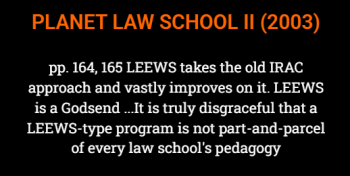
LEEWS takes the old IRAC approach and vastly improves on it. LEEWS is a Godsend ...It is truly disgraceful that a LEEWS-type program is not part-and-parcel of every law school's pedagogy.
— PLANET LAW SCHOOL II (2003), pp. 164, 165
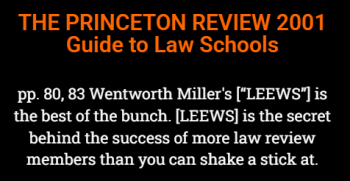
There are lots of commercial programs and aids designed to assist law students in studying for and writing exams, but—trust us—Wentworth Miller's ["LEEWS"] is the best of the bunch. [LEEWS] is the secret behind the success of more law review members than you can shake a stick at. You really should check it out.
— THE PRINCETON REVIEW 2001 Guide to Law Schools, pp. 80, 83